How a modern recording (24-bit, 48 kHz, often stereo) becomes a ProTracker sample (8-bit, mono, 8363 Hz, which plays at the note C-2).
Try it live: interactive simulations of aliasing, dither and the error moments.
Notation: input $x_L[n], x_R[n]$ at $f_i = 48000$ Hz, output rate $f_o = 8363$ Hz, 8-bit step $q = 2/2^8 = 2^{-7}$ on the range $[-1, 1)$.
1. Stereo to mono
\[x_m[n] = \tfrac12\bigl(x_L[n] + x_R[n]\bigr) \tag{1}\]Content that is out of phase between the channels cancels. Kick and bass sit in the centre, so they lose nothing.
2. Low-pass, then resample
Sampling at $f_o$ repeats the spectrum at every multiple of $f_o$:
\[X_s(f) = f_o \sum_{k \in \mathbb Z} X(f - k f_o) \tag{2}\]Where the copies overlap, you get aliasing. A tone at $f$ appears at
\[f_a = \bigl|\, f - f_o \,\mathrm{round}(f / f_o) \bigr| \tag{3}\]| so 7000 Hz becomes $ | 7000 - 8363 | = 1363$ Hz. After sampling, these points are identical to a real 1363 Hz tone, so the filter must act before sampling: $ | H(f) | \approx 0$ for $ | f | \ge f_o/2 = 4181.5$ Hz. |
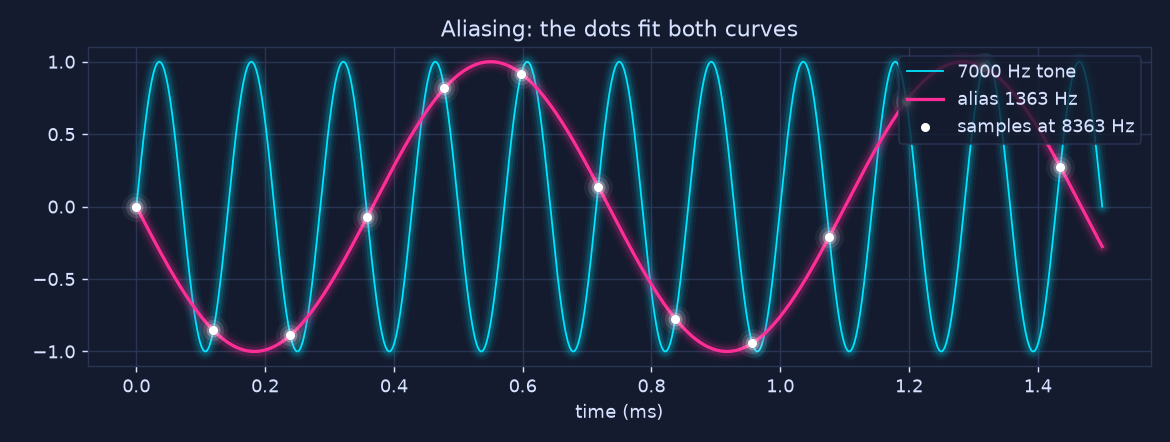
A sharper filter edge means less aliasing but a longer filter, which rings slightly before transients (pre-ringing).
3. Normalise
\[z[m] = g\, y[m], \qquad g = \frac{10^{-0.3/20}}{\max_m |y[m]|} \approx \frac{0.966}{\max_m |y[m]|} \tag{4}\]8 bits give 256 levels, about 6 dB per bit and 48 dB in total. A quiet sample uses only a few of them.
4. Dither, then round to 8 bits
The quantizer rounds to the nearest step:
\[Q(u) = q \left\lfloor \frac{u}{q} + \frac12 \right\rfloor \tag{5}\]Without dither, the error $e = Q(z) - z$ is a fixed function of the signal. It follows the music and sounds like distortion, and quiet tails turn into steps or cut to silence.
With TPDF dither, two independent uniform values are added before rounding:
\[d = u_1 + u_2,\quad u_i \sim \mathcal U\!\left(-\tfrac q2, \tfrac q2\right), \qquad w = Q(z + d), \qquad \nu = w - z \tag{6}\]The error then has a mean and a variance that do not depend on the signal:
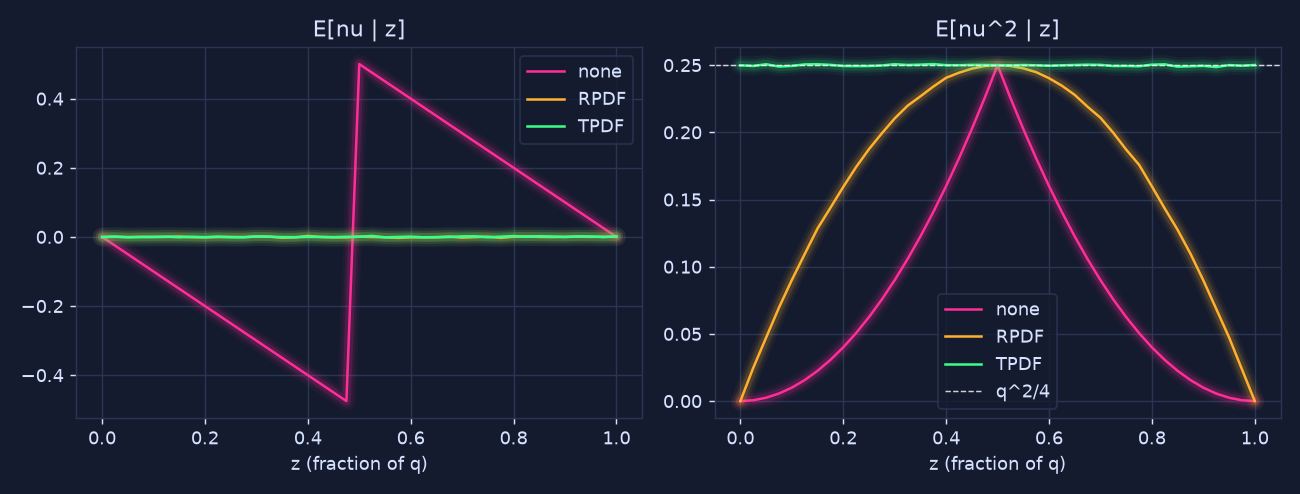
\[\mathbb E[\nu \mid z] = 0, \qquad \mathbb E[\nu^2 \mid z] = \frac{q^2}{12} + \frac{q^2}{6} = \frac{q^2}{4} \tag{7}\]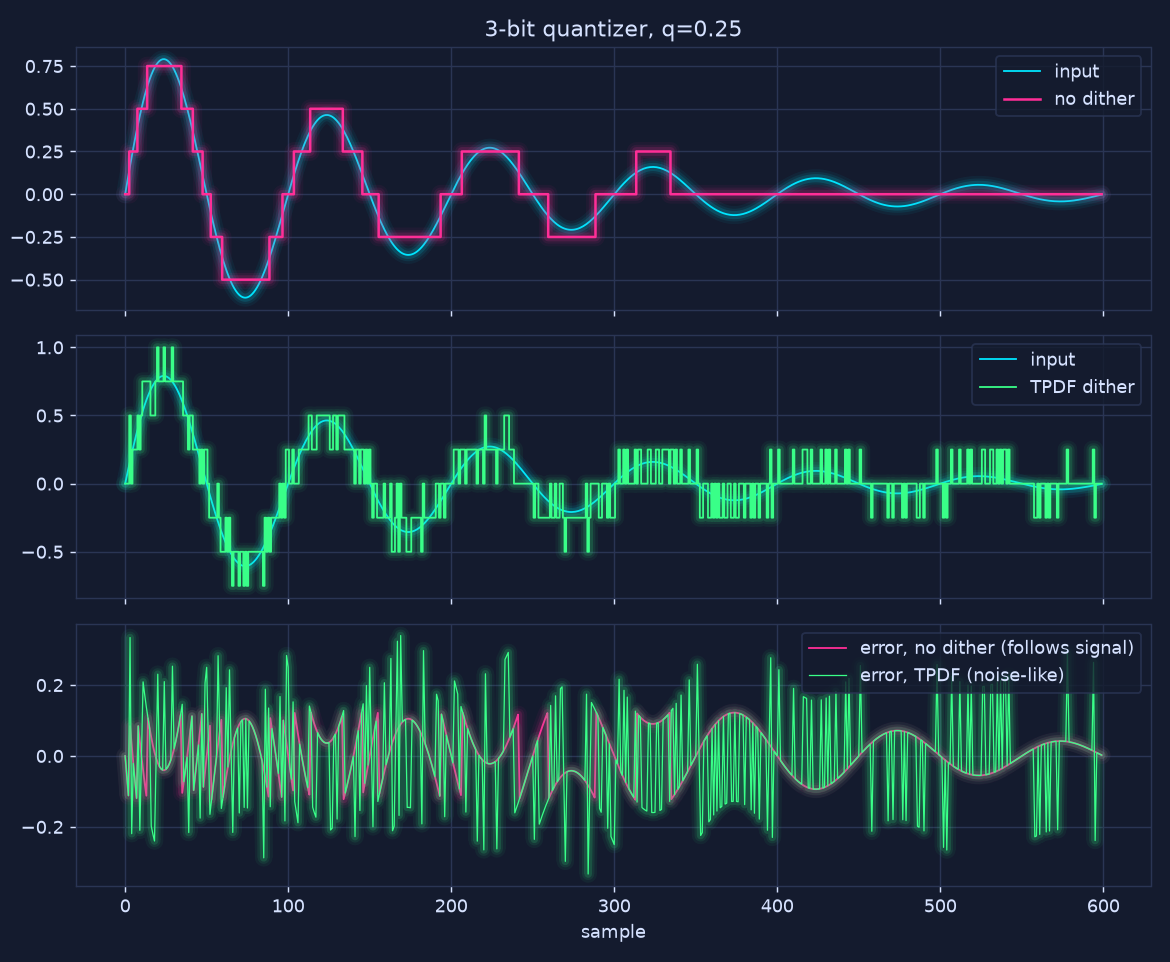
Why two uniform values and not one
The quantizer error is periodic in $u$ with period $q$, so it has a Fourier series with frequencies $a_k = 2\pi k / q$. Averaging over the dither multiplies each term by the dither’s characteristic function $\Phi_d(a_k)$. The mean error vanishes for every $z$ when $\Phi_d(a_k) = 0$, and the variance stops depending on $z$ when also $\Phi_d’(a_k) = 0$, for all $k \ne 0$.
One uniform value has $\Phi_u(\omega) = \dfrac{\sin(\omega q/2)}{\omega q/2}$: simple zeros at $a_k$, so the mean is fixed but the variance still moves with the signal (RPDF dither). The sum of two independent ones has
\[\Phi_d(\omega) = \Phi_u(\omega)^2 = \left(\frac{\sin(\omega q/2)}{\omega q/2}\right)^2 \tag{8}\]with a double zero at every $a_k$, so both conditions hold. A Monte Carlo check (200 000 draws per point) confirms it:
Signal-to-noise ratio
For a full-scale sine ($P_s = \tfrac12$):
\[\mathrm{SNR}_{\text{plain}} = 10 \log_{10} \frac{1/2}{q^2/12} \approx 49.9 \text{ dB}, \qquad \mathrm{SNR}_{\text{TPDF}} = 10 \log_{10} \frac{1/2}{q^2/4} \approx 45.2 \text{ dB} \tag{9}\]Dither costs 4.8 dB of noise and removes distortion that follows the signal.
What is lost, and why kick and bass survive
Everything above about 4 kHz goes, the attack gets a little softer, and a noise floor appears around −45 to −50 dB. Kick and bass have most of their energy below 1 kHz, so the filter barely touches them, and their loud, short shape masks the noise.
From formula to code
| Equation | In scripts/demo.py |
In the SoX chain |
|---|---|---|
| (1) mono | n/a | remix 1 |
| (2)–(3) aliasing | figure 1 | rate -v 8363 |
| (4) normalise | n/a | gain -n -0.3 |
| (5) quantizer | quant(u, q) |
-b 8 |
| (6)–(8) TPDF dither | figures 2 and 3 | dither (TPDF by default, placed last) |
Plain dither is used on purpose: SoX’s noise-shaping variant (dither -s) only has filters for some sample rates, and 8363 Hz is not one of them.
Re-render the figures
cd docs/sample-conversion/scripts
uv run --with numpy --with matplotlib demo.py
The script writes the three PNG files to ../figures/, which updates this page. Edit quant() or the dither lines to see how the error changes.
References
BibTeX for everything below: references.bib.
- Sampling and aliasing: Nyquist (1928), Shannon (1949); Söderkvist, Tidsdiskreta signaler & system (Linköping), a Swedish textbook on sampling and discrete-time systems; Oppenheim and Schafer, Discrete-Time Signal Processing (3rd ed., 2010); Crochiere and Rabiner, Multirate Digital Signal Processing (1983) for non-integer rate conversion.
- Dither: Wannamaker, Lipshitz, Vanderkooy and Wright, “A Theory of Nonsubtractive Dither”, IEEE Trans. Signal Processing 48(2), 2000. The derivation above follows it. See also Lipshitz, Wannamaker and Vanderkooy, “Quantization and Dither: A Theoretical Survey”, JAES 40(5), 1992, and Widrow and Kollár, Quantization Noise (2008).
- Digital audio in practice: Huber and Runstein, Modern Recording Techniques (7th ed., 2010); Rumsey and McCormick, Sound and Recording: An Introduction (5th ed., 2006).
- Sampling culture: Schloss, Making Beats: The Art of Sample-Based Hip-Hop (2014).
- Tools and platform: the SoX manual (
rate,dither); the Amiga Hardware Reference Manual (1989 edition, for Kickstart 1.3) for the Paula chip. The 8363 Hz rate is the NTSC Amiga clock, 3 579 545 Hz, divided by the C-2 period 428.